
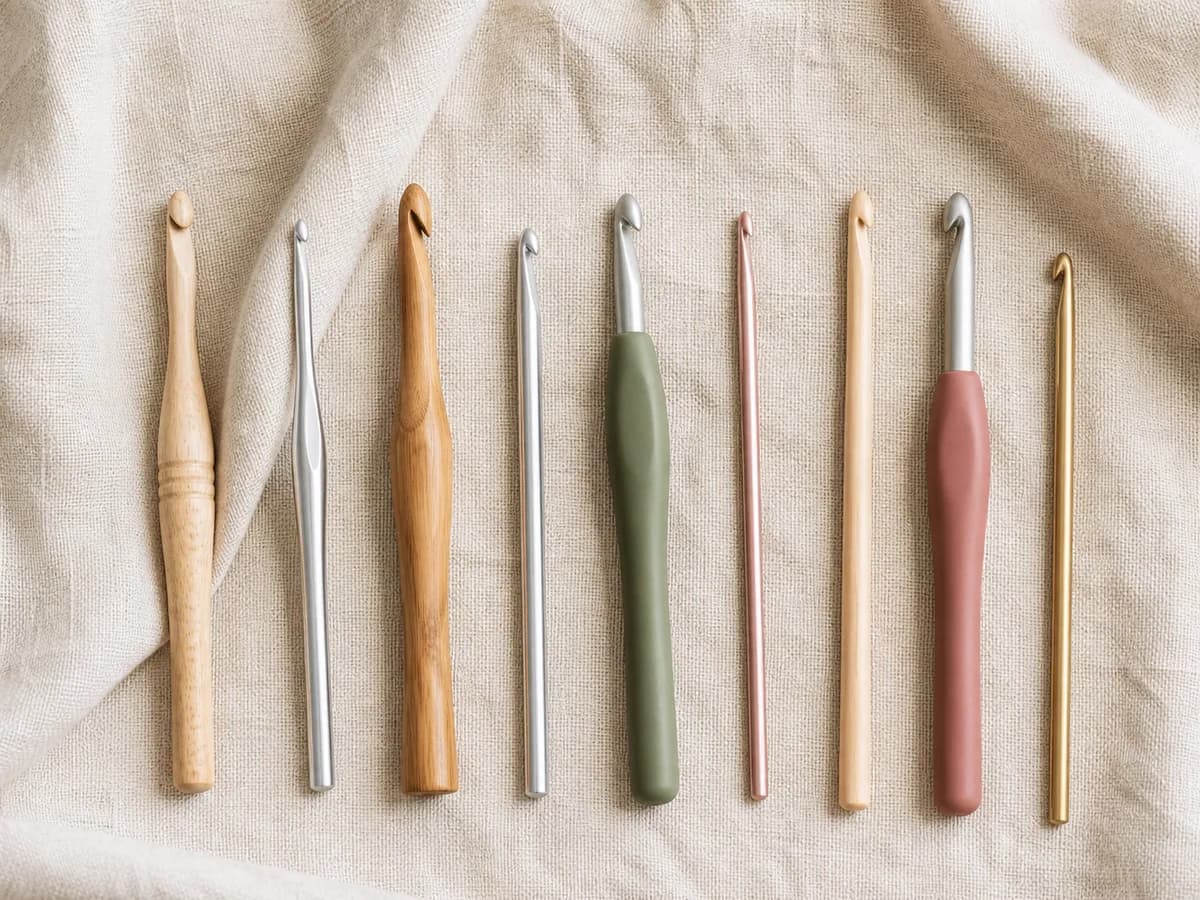
A crochet hook has up to three names. The same tool is sold as 5.5 mm in one shop, US I-9 in another, and turns up in your grandmother's tin stamped UK 5. Patterns switch between the systems without warning, which is why the wrong hook is one of the most common reasons a project comes out the wrong size.
Here is the full conversion, and then the part most charts leave out: which hook actually belongs with which yarn.
Crochet hook conversion chart
| Metric | US | UK / old Canadian | Typical yarn |
|---|---|---|---|
| 2.25 mm | B-1 | 13 | Super fine |
| 2.50 mm | — | 12 | Super fine |
| 2.75 mm | C-2 | 11 | Super fine |
| 3.125 mm | D | — | Super fine |
| 3.25 mm | D-3 | 10 | Super fine |
| 3.50 mm | E-4 | 9 | Super fine, Fine |
| 3.75 mm | F-5 | — | Fine |
| 4.00 mm | G-6 | 8 | Fine |
| 4.25 mm | G | — | Fine |
| 4.50 mm | 7 | 7 | Fine, Light |
| 5.00 mm | H-8 | 6 | Light |
| 5.25 mm | I | — | Light |
| 5.50 mm | I-9 | 5 | Light, Medium |
| 5.75 mm | J | — | Medium |
| 6.00 mm | J-10 | 4 | Medium |
| 6.50 mm | K-10½ | 3 | Medium, Bulky |
| 7.00 mm | — | 2 | Bulky |
| 8.00 mm | L-11 | 0 | Bulky |
| 9.00 mm | M/N-13 | 00 | Bulky, Super bulky |
| 10.00 mm | N/P-15 | 000 | Super bulky |
| 11.50 mm | P-16 | — | Super bulky |
| 12.00 mm | — | — | Super bulky |
| 15.00 mm | P/Q | — | Super bulky, Jumbo |
| 15.75 mm | Q | — | Jumbo |
| 16.00 mm | Q | — | Jumbo |
| 19.00 mm | S | — | Jumbo |
| 25.00 mm | T/U/X | — | Jumbo |
| 30.00 mm | T/X | — | Jumbo |
Millimetre sizes and US letters follow common industry conventions. The UK column lists the traditional numbers still printed on older hooks and vintage patterns.
When the labels disagree, trust the millimetres. US letters and numbers are not standardised between manufacturers — one brand's G is 4 mm, another's is 4.25 mm. The millimetre figure is a physical measurement of the shaft, so it means the same thing everywhere.
Which hook goes with which yarn
| Yarn weight | Also called | Hook range |
|---|---|---|
| 0 — Lace | Lace, 10-count thread | 1.6–1.4 mm steel; 2.25 mm regular |
| 1 — Super Fine | Sock, fingering, baby | 2.25–3.5 mm |
| 2 — Fine | Sport, baby | 3.5–4.5 mm |
| 3 — Light | DK, light worsted | 4.5–5.5 mm |
| 4 — Medium | Worsted, afghan, aran | 5.5–6.5 mm |
| 5 — Bulky | Chunky, craft, rug | 6.5–9 mm |
| 6 — Super Bulky | Super bulky, roving | 9–15 mm |
| 7 — Jumbo | Jumbo, roving | 15 mm and larger |
The hook on the yarn band is a starting point, not an instruction. It is the size that produces a fabric most people find pleasant for that thickness of yarn — not too stiff, not too holey.
You deliberately step outside that range in three situations:
- Amigurumi. Go one or two sizes smaller. A tight fabric is the whole point: stuffing must not show through the stitches.
- Garments and shawls. Go one size larger for drape. A cardigan worked at blanket density will stand up on its own.
- Matching a pattern's gauge. This overrides everything else. Tighter than the pattern, size up; looser, size down.
Steel hooks run backwards
Steel hooks — for crochet thread, doilies and fine lace — use their own numbering, and it runs in reverse: the bigger the number, the smaller the hook. They range from roughly 3.5 mm (size 00) down to 0.75 mm (size 14).
A steel 7 and an aluminium 7 are nowhere near the same tool. Check which system a thread pattern means before you buy.
The four hooks worth owning first
If you are building a set rather than buying a 22-piece kit, these cover the great majority of published patterns:
- 4 mm (G-6) — DK yarn, amigurumi in worsted, granny squares.
- 5 mm (H-8) — the most called-for size in worsted-weight patterns.
- 5.5 mm (I-9) — worsted blankets and anything wanting a softer fabric.
- 6.5 mm (K-10½) — chunky yarn, fast blankets, winter accessories.
Add half sizes later, when a gauge swatch tells you that you need one. That is the only reliable signal for which hook to buy next.