
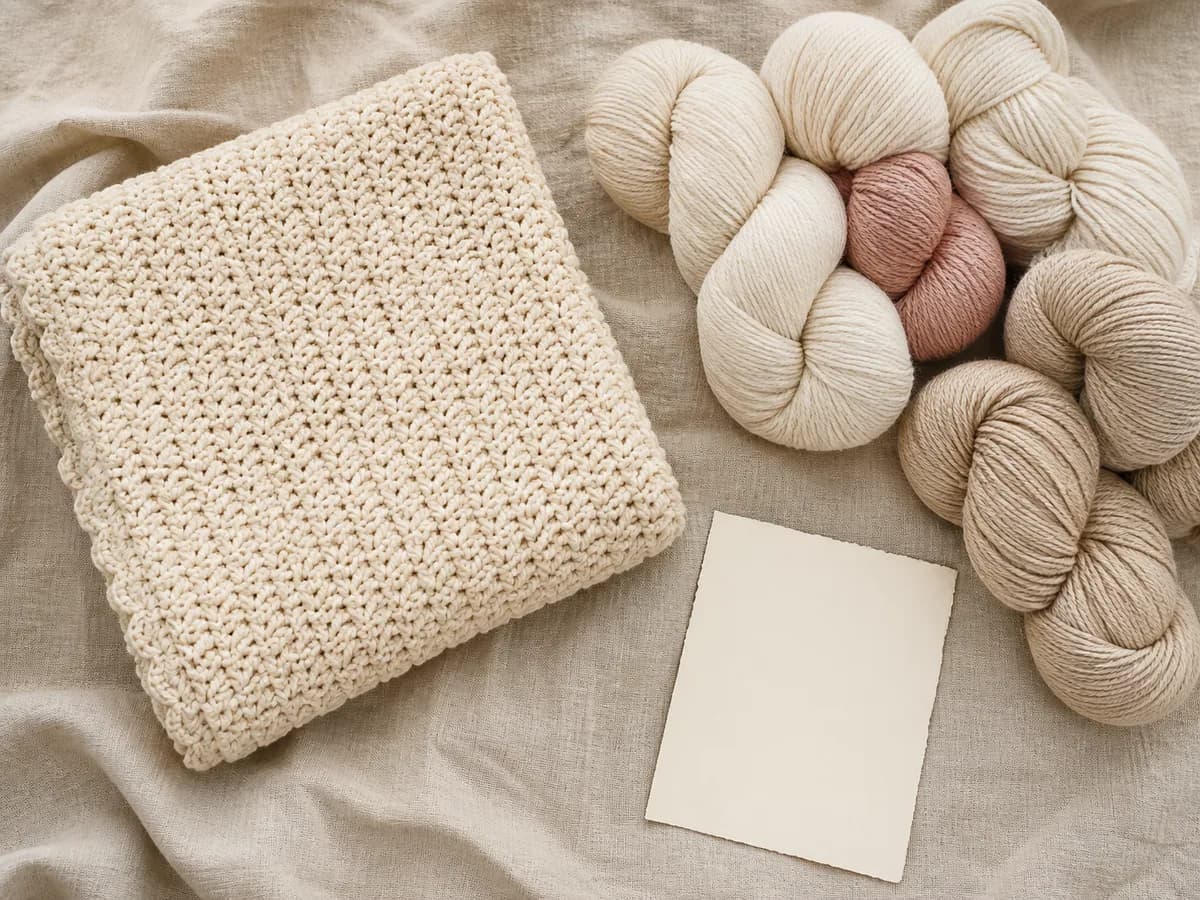
There is no single answer, because two crocheters can work the same blanket in the same yarn and one will use 400 yards more than the other. Yardage depends on size, yarn weight, stitch — and the part most charts ignore, your own tension.
So there are two ways to answer it. The quick estimate gets you close enough to shop with. The swatch method gets you close enough to avoid a second trip.
Quick reference: yardage by blanket size
Worsted-weight (category 4) yarn worked in double crochet, the most common blanket combination.
| Blanket | Size (in) | Worsted yardage |
|---|---|---|
| Lovey | 14 × 14 | 125–150 yd |
| Preemie | 18 × 24 | 275–350 yd |
| Stroller / car seat | 30 × 36 | 675–875 yd |
| Receiving blanket | 30 × 40 | 750–950 yd |
| Lapghan | 36 × 48 | 1,100–1,400 yd |
| Toddler / crib | 42 × 52 | 1,375–1,750 yd |
| Throw / afghan | 50 × 60 | 1,875–2,400 yd |
| Twin | 66 × 90 | 3,725–4,750 yd |
| Full / double | 80 × 90 | 4,525–5,775 yd |
| Queen | 90 × 100 | 5,650–7,200 yd |
| King | 108 × 100 | 6,775–8,650 yd |
Always buy the top of the range. Yarn is dyed in batches, and two skeins of the same colour from different lots will not match in daylight. Buying the extra skein now costs a few dollars. Buying it in four months, when the lot has sold out, costs you the last two rows of the blanket.
The swatch method, step by step
The most useful approach is the one that accounts for how you crochet. It takes a little longer but is more reliable than a generic chart.
- Weigh your ball on a kitchen scale and write the number down.
- Work a swatch at least 4 × 4 inches in the exact yarn, hook and stitch pattern you plan to use.
- Weigh the ball again. The difference is the grams your swatch consumed.
- Measure the swatch and multiply width by height for its area in square inches.
- Divide grams used by square inches, then multiply by the area of your planned blanket.
Convert to skeins by dividing by the ball weight on the label. Add a safety margin, especially for textured stitches, joins, or a border. Ten percent is a practical starting point when you cannot easily buy the same dye lot later.
What changes the number most
The stitch, by a wide margin
Stitch choice moves yardage more than anything except size. The same blanket in single crochet instead of double crochet uses roughly a fifth more yarn, because you are packing more, shorter stitches into the same area.
Textured stitches — bobbles, waffle, cables, anything with front and back post stitches — can add 25 to 30 percent. Open work such as granny squares and mesh uses dramatically less, since a good share of the blanket is holes.
Yarn weight
Thicker yarn covers area faster in yards, but each yard weighs more, so the total in grams stays closer than you would expect. Rough consumption per square inch of solid single crochet:
| Weight | Names | Yards per sq in |
|---|---|---|
| 1 — Super Fine | Sock, fingering | 1.9 |
| 2 — Fine | Sport | 1.4 |
| 3 — Light | DK | 1.1 |
| 4 — Medium | Worsted | 0.85 |
| 5 — Bulky | Chunky | 0.55 |
| 6 — Super Bulky | Roving | 0.34 |
These are estimates from typical fabric, not standards. Your swatch beats them.
Tension
A tight crocheter can use 15 percent more yarn than a loose one working the identical pattern, because tighter stitches mean more stitches per inch. If you know your gauge runs tight, add that margin on top of any chart.
Borders and joins
A simple single-crochet border adds a percent or two. A deep ruffled or shell border can add eight to ten. Blankets made from motifs need extra for joins and for weaving in ends — and if you are making 63 granny squares, that is a real quantity of yarn.
On "how many skeins". Skein sizes vary far more than people expect: a standard worsted ball might be 170 yards, a value pack 364, a budget cone 800. Always work in yards or metres first, then divide by the yardage printed on the label of the specific yarn you are buying.