
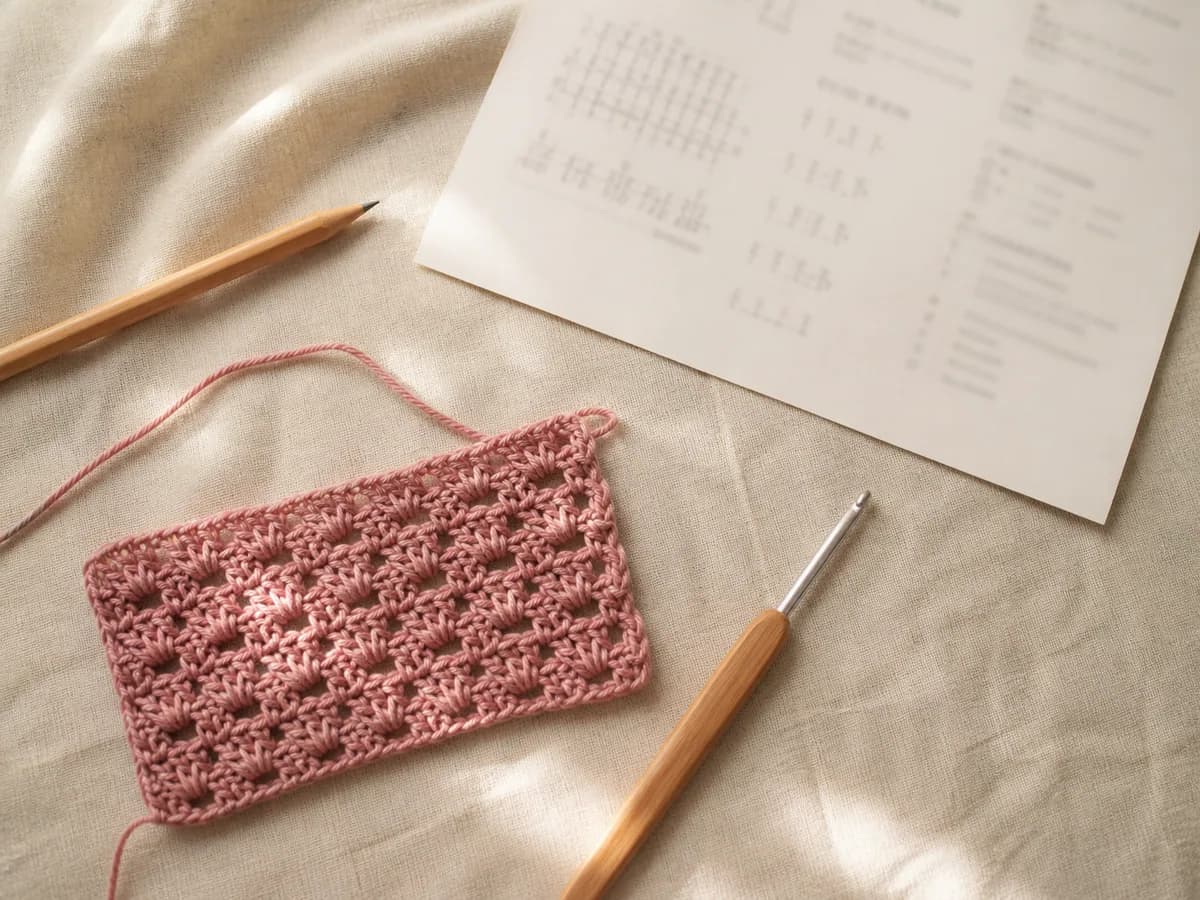
A crochet pattern is a compressed set of instructions, and like any compressed format it is unreadable until you know the scheme. Once you do, a line like Row 4: ch 1, sc in first st, *dc in next 3 sts, sc in next st; rep from * to end, turn. (41 sts) becomes completely plain.
Start here: US or UK?
This is the trap that ruins finished objects, because both systems use the same words for different stitches. A US double crochet and a UK double crochet are not the same height — a project worked in the wrong system comes out the wrong size and density, but is otherwise perfectly executed, so the mistake is invisible until it is finished.
| US term | UK term |
|---|---|
| Single crochet (sc) | Double crochet (dc) |
| Half double crochet (hdc) | Half treble crochet (htr) |
| Double crochet (dc) | Treble crochet (tr) |
| Treble crochet (tr) | Double treble crochet (dtr) |
| Double treble (dtr) | Triple treble (trtr) |
| Slip stitch (sl st) | Slip stitch (ss) |
| Skip (sk) | Miss |
| Gauge | Tension |
| Yarn over (yo) | Yarn round hook (yrh) |
How to tell which one a pattern uses: look for the words single crochet. The term does not exist in UK terminology, so its presence proves the pattern is US. If you see treble constantly and no single crochet at all, it is UK. "Tension" rather than "gauge", and hook sizes in millimetres only, are a second UK signal.
The punctuation is the grammar
Asterisks * — repeat from here
*dc in next 3 sts, sc in next st; rep from * to end means: do everything between the asterisk and the semicolon, then go back to the asterisk and do it again, until you reach the end of the row.
Parentheses ( ) — a group worked in one place
(2 dc, ch 2, 2 dc) in next ch-sp means all of that goes into the same single space. This is how corners are made.
Brackets [ ] — a group repeated a set number of times
[dc in next st, ch 1] 5 times — do those two things, five times over. Some designers swap the meanings of brackets and parentheses, so check the pattern's own key if it has one.
The number at the end of the row
(41 sts) is your stitch count, and it is the most useful thing in the whole pattern. Count at the end of every row against it. If it matches, the row is right; if not, the error is in that row and nowhere else, and you have lost one row rather than twenty.
Common abbreviations
| Abbreviation | Means |
|---|---|
| ch | chain |
| st / sts | stitch / stitches |
| sl st | slip stitch |
| sc | single crochet |
| hdc | half double crochet |
| dc | double crochet |
| tr | treble crochet |
| inc | increase — 2 stitches in one stitch |
| dec | decrease — 2 stitches worked together |
| sc2tog | single crochet 2 together |
| rep | repeat |
| rnd | round |
| RS / WS | right side / wrong side |
| FO | fasten off |
| blo / flo | back loop only / front loop only |
| fpdc / bpdc | front post / back post double crochet |
| sp | space |
| MC / CC | main colour / contrast colour |
Reading a row, word by word
Row 4: ch 1, sc in first st, *dc in next 3 sts, sc in next st; rep from * to end, turn. (41 sts)
- ch 1 — turning chain, to reach the height of a single crochet. Not counted as a stitch here.
- sc in first st — into the very first stitch, confirming the turning chain is not counted.
- *dc in next 3 sts, sc in next st — the repeat: a 4-stitch unit.
- rep from * to end — keep repeating that unit until you run out of stitches.
- turn — flip the work to start the next row.
- (41 sts) — count. You should have 41.
Sizes written inline
Garment patterns give multiple sizes at once: ch 60 (66, 72, 78) — the first number is the smallest size, the numbers in parentheses are the larger ones in order.
Before you start, go through the whole pattern and circle every number for your size. Five minutes, and it prevents the classic mistake of drifting into a different size halfway down the page.
Rounds are not rows
Rnd means you are working in a spiral or a joined circle rather than back and forth. Two conventions exist and the pattern must tell you which:
- Joined rounds end with a slip stitch into the first stitch and usually a turning chain, giving a visible seam.
- Continuous spirals never join, giving smooth fabric — standard for amigurumi — and requiring a stitch marker in the first stitch of each round, because otherwise you will lose your place. Not "might". Will.